





Keeping Gases Pure for Laboratory Use
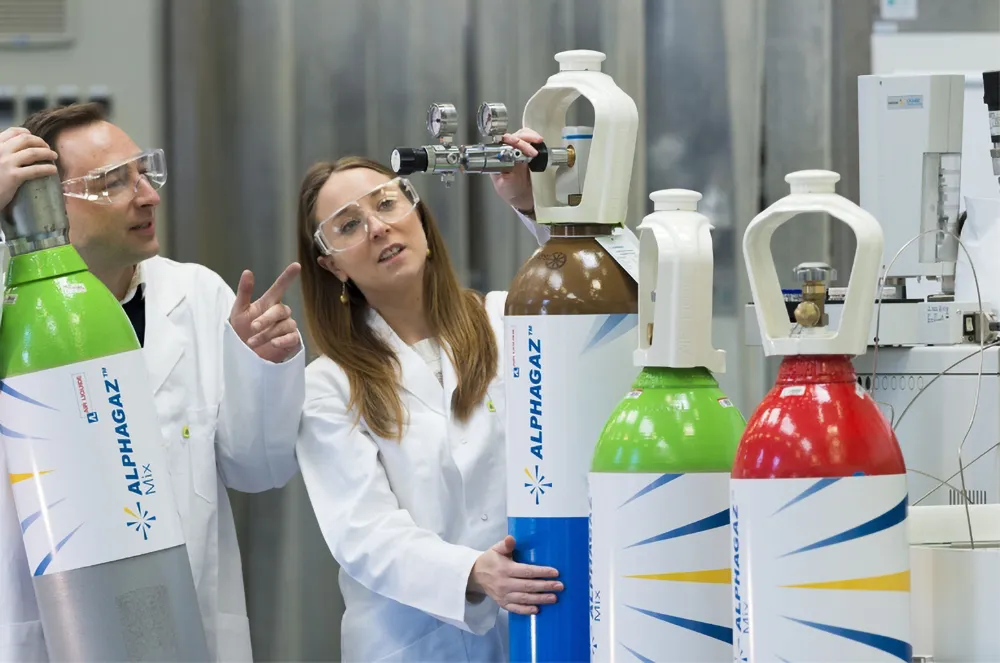
Air Liquide has gases in its range with an especially high degree of purity – known as the Alphagaz product line – specifically intended for the lab environment. But there’s also a wide range of specialised pressure equipment available for lab use. And that’s needed because gas purity has to be guaranteed right up to the moment it is used. Put simply, there is little point in using high-purity gases if they then become contaminated by equipment that’s not up to the task.
Safety and quality go hand in hand
"It's all about ensuring that the measurement conditions in the lab are as meticulous and consistent as possible," explains Stefan Suys, Air Liquide's Product Manager Equipment & Installations, North-West Europe Cluster. "But of course it’s also important to work in safe conditions. By using equipment that has been specifically developed for laboratory use, you assure quality control on the one hand and improve safety on the other."
"Impurities often occur when industrial equipment – such as regulators for welding – is used instead of equipment suited to lab application," Stefan continues. "The differences between equipment for industrial use and equipment for high-purity applications are greater than you might initially suspect. For example, regulators for lab use have better leak protection thanks to their particular design and high specification. These regulators also have a low internal dead volume and use bellows technology. Industrial pressure-reducing valves don’t have these features. So the higher-priced lab-grade equipment quickly pays for itself because they guarantee more reliable test results."
"A second factor leading to impurities is using incorrect couplings or hoses. The fact is that any connection or joint which gas passes through can be a potential source of leakage or contamination. So we recommend choosing suitable cutting ring couplings when connecting copper or stainless steel pipes. And where a flexible hose is used, it’s advisable to check its compatibility with the gas being used and the quality requirements. Practical information on this subject can be found in Air Liquide's online gas encyclopaedia."
Flushing: tips and tricks
Another critical factor for gas quality is using the correct flushing procedure. Every time cylinders are changed or a high pressure hose or cylinder is disconnected, atmospheric air enters the high pressure hose. To avoid this, you have to flush the hose before opening the installation’s service valve. Depending on the application, the quality requirements, and the gas used, more or fewer flushing cycles will be needed. This is explained further in the video.
Gas cylinders connected by means of a high-pressure reducer do not have flushing systems as standard, which means that it’s not easy to adequately flush the circuit. This can be resolved by installing the necessary equipment downstream, but a better solution is to install a switchover system – a panel or switchboard – outside, or inside a protective cylinder cage.
Such a gas installation is equipped with a flushing system as standard, and it’s also safer, because the gas pressure can be reduced before it enters the structure. Our specialists are happy to help you choose the right equipment, as well as optimize lab workflow and safety.